

French roulette is a classic roulette variant played on a wheel with 37 pockets. The numbers run from 1 to 36, plus a single zero. This is what distinguishes French and European roulette from American roulette, which also includes a double-zero pocket.
French roulette also has its own terminology, table layout, and rules such as partage and en prison. Understanding these features makes it easier to follow a game and choose your bets with a clear idea of how they work.
How a Game of French Roulette Works
Before each spin, players place their chips on the betting layout. Each position corresponds to a number, a group of numbers, or a particular characteristic of the result.
The croupier spins the wheel in one direction and releases the ball in the opposite direction. Once bets are closed, no new selections can be added. The ball slows down, drops into a pocket, and determines the winning number.
A game generally follows these steps:
- Choose the chip value.
- Select one or more bets.
- Confirm your bet before betting closes.
- Wait for the ball to come to rest.
- Check the result and any winnings.
- Prepare your bets for the next spin.
Players in jurisdictions where this type of gambling is permitted can check Madnix online casino as an example of a platform and see whether a French roulette table is currently available. Always check the game’s rules, limits, and features directly on its information page before placing a bet.

The Main Differences Between Roulette Variants
French and European roulette both have 37 pockets. Their standard house edge is therefore the same when special rules do not apply.
However, the table layout and terminology are different. A traditional French roulette table uses terms such as manque, passe, pair, impair, cheval, and transversale.
| Variant | Number of pockets | Zeros | Standard house edge |
| French roulette | 37 | Single zero | Approximately 2.70% |
| European roulette | 37 | Single zero | Approximately 2.70% |
| American roulette | 38 | Single and double zero | Approximately 5.26% |
On some French roulette tables, the partage or en prison rules reduce the mathematical house edge on even-money bets when the ball lands on zero. These rules are not necessarily available in every online version.
Understanding the Roulette Table
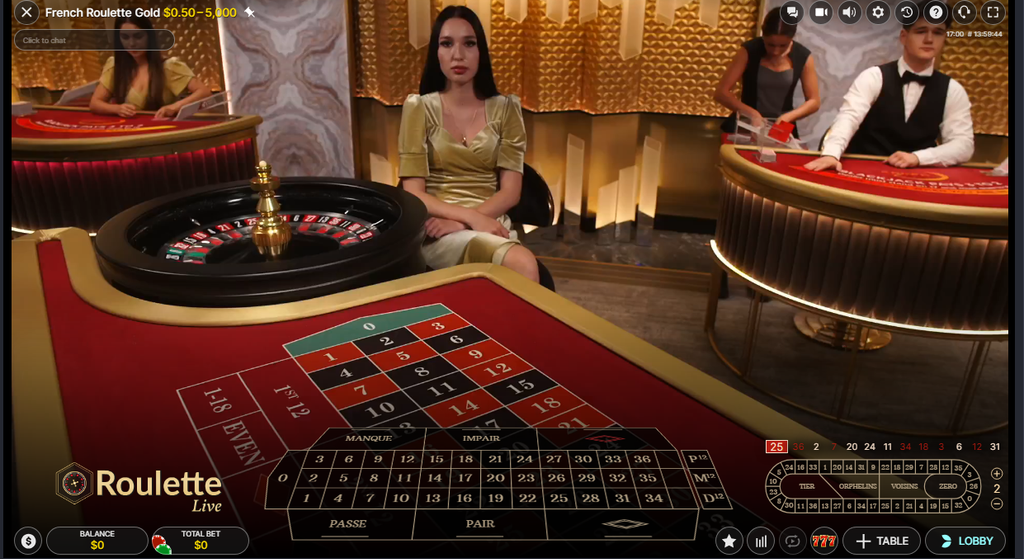
The table contains numbers from 0 to 36, along with several areas for outside bets. Inside bets cover a single number or a small group of numbers, while outside bets cover larger groups.
Inside Bets
Inside bets offer higher potential payouts but cover fewer possible outcomes.
- Straight-up — a bet on a single number
- Split — covers two adjacent numbers
- Street — covers a row of three numbers
- Corner — covers four numbers
- Six line — covers two rows, or six numbers
A winning straight-up bet pays 35 to 1, in addition to returning the original stake. A split pays 17 to 1, a street 11 to 1, a corner 8 to 1, and a six line 5 to 1.
Outside Bets
Outside bets cover more numbers, so their payouts are lower.
- Red or black — covers the selected color
- Odd or even — covers odd or even numbers
- Low — covers numbers 1 to 18
- High — covers numbers 19 to 36
- Dozen — covers 1–12, 13–24, or 25–36
- Column — covers one of the three vertical columns on the table
Even-money bets such as red, black, odd, even, low, and high pay 1 to 1. Dozens and columns pay 2 to 1.
The zero does not belong to any even-money bet. It is neither red nor black, neither odd nor even, and is not included in low or high.
The Partage Rule
Partage applies when the ball lands on zero and the player has placed an even-money bet.
Instead of losing the entire stake, the player receives half of it back. For example, with a €20 bet on red, a zero result may return €10 if the partage rule is applied.
This rule reduces the theoretical house edge to approximately 1.35% on the bets concerned. It generally does not apply to straight-up, split, corner, column, or dozen bets.
The En Prison Rule
En prison is another way of handling a zero result. When zero appears, a stake placed on an even-money bet remains on the table for the next spin.
If the selected bet wins on the following spin, the stake is normally released without any additional profit. If it loses, the casino keeps the stake. The treatment of a second zero can vary depending on the table’s rules.
Traditional French rules allow players to choose between receiving half of their stake back and leaving it en prison. This system is described in the French regulations applicable to roulette.
Online, check the game’s paytable to see whether it offers partage, en prison, or neither option.
Announced Bets
Some tables feature an oval track known as the racetrack. It allows players to select groups of numbers that are close to each other on the wheel rather than on the numbered betting layout.
Neighbours of Zero
This selection covers the section of the wheel around zero. It uses several chips distributed across different straight-up, split, and street bets.
Thirds of the Wheel
Thirds of the wheel cover twelve numbers located on the side of the wheel opposite zero. The chips are generally distributed across six split bets.
Orphans
Orphans are the numbers that are not included in either Neighbours of Zero or Thirds of the Wheel. The bet usually combines one straight-up bet with several split bets.
Zero Game
The Zero Game covers a smaller group of numbers close to zero. It should not be confused with a bet placed solely on the number zero.
The total cost of these selections depends on the number of chips required. The interface should show the distribution before the bet is confirmed.
How to Place a Bet Online
On a digital roulette table, you generally select a chip value and then click or tap the desired area. Multiple clicks on the same position increase the stake.
Commonly available controls include:
- Undo the last bet
- Clear all selections
- Repeat the previous round’s bets
- Double the displayed bets
- View the results history
- Turn sound notifications on or off
On a live dealer table, players are given a short period to place their chips. Once the croupier announces that betting is closed, betting controls become unavailable.
Probabilities and the House Edge
A specific number has a 1 in 37 probability of appearing on each spin. This probability remains the same even if that number has not appeared for a long time.
An even-money bet covers 18 winning numbers out of the 37 pockets. The zero creates the difference between the actual probability and the 1-to-1 payout. This difference is what produces the casino’s house edge.
Previous results do not affect the next spin. A streak of black numbers does not automatically make red more likely. The history can be used to review previous spins, but it cannot predict which pocket will win next.
Do Betting Systems Work?
Systems such as the Martingale, Fibonacci, and D’Alembert change the amount wagered based on previous results. However, they do not change the wheel’s probabilities or the mathematical house edge.
A progression can also be interrupted by:
- A losing streak
- The table’s maximum bet limit
- Running out of available funds
- A rapid increase in the required stake
A flat betting approach is easier to track and makes it immediately clear how much money is exposed on each spin.
Roulette and Crash Games
Roulette is based on an independent draw in which the result corresponds to a pocket on the wheel. Crash games use a multiplier that increases until a random stop. The player must cash out before the stop to keep the payout associated with the multiplier.
Despite their different interfaces, both categories rely on an unpredictable outcome and retain a mathematical advantage for the operator. To compare these mechanisms, this guide to popular crash games in France covers several well-known titles and their main features.
What to Check Before Playing
Before selecting a table, check the exact game version, the number of zeros, betting limits, and the rules that apply when zero appears. A roulette game labelled as French does not automatically guarantee that partage or en prison is available.
You should also check the legal framework that applies where you live. In France, the National Gambling Authority (Autorité nationale des jeux) states that online casino games, including roulette, are not among the categories of gambling permitted on the internet. Roulette may, however, be offered in land-based casinos that hold the required authorization.